Is Your Marriage Drifting While You Lead?
How Business Leaders Can Recognize Marriage Drift and Protect What Matters Most
Executive Summary
- The demands of executive leadership can create conditions that weaken a marriage: limited time, decision fatigue, travel, constant responsibility, and diminishing emotional margin.
- Marriage drift rarely begins with a crisis. It develops gradually when a relationship is expected to survive on good intentions and whatever attention remains.
- Strong marriages require deliberate stewardship through protected connection, honest conversation, and accountability before distance becomes dysfunction.
By C12 Editorial Team
Christian CEO Peer Advisory & Business as a Ministry Contributors
October 2026 | 7-Minute Read
Pillar: CEO Stewardship & Leadership Weight
You’d never expect your business to thrive on leftover time, attention, or resources. You wouldn’t postpone strategy until things calm down, ignore warning signs until a crisis develops, or consistently give the company whatever energy remains after every other priority has been addressed.
Yet it can be easy for successful leaders to approach their marriages that way.
As calendars fill, travel increases, and the business demands greater focus, your marriage can gradually become the relationship expected to absorb whatever margin remains.
Conversations increasingly revolve around schedules, problems, and logistics rather than friendship, intimacy, and shared purpose. Nothing may be obviously broken, yet the relationship can still be losing the closeness that once came naturally.
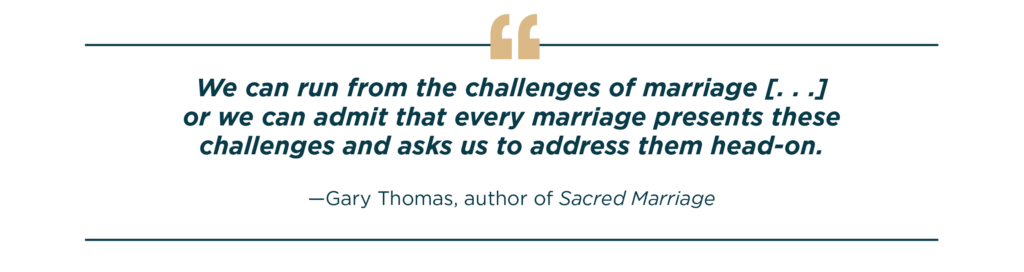
That is marriage drift: the gradual loss of connection caused by busyness, distraction, competing priorities, and the assumption that a strong relationship will remain strong without deliberate investment. Because the drift is often quiet, leaders can overlook it until the distance becomes difficult to ignore.
For Christian leaders, marriage is more than another relationship competing for space on the calendar. It’s one of the primary relationships God has entrusted to our care. Faithful stewardship means paying attention to what we’ve been given before neglect becomes loss.
We can’t address what we haven’t first recognized. By identifying the pressures that can quietly create distance at home, we can respond intentionally before those patterns become deeply rooted.
Challenge #1: When Success Consumes Your Best Energy
Executive leadership carries legitimate demands. Decisions have consequences, opportunities move quickly, and responsibility rarely fits neatly inside business hours. The problem develops when a temporary imbalance quietly becomes the permanent operating model.
Over time, your spouse may consistently encounter the most depleted version of you. You’re physically present but mentally working through tomorrow’s decisions. You have patience for a difficult conversation at work but little capacity for one at home.
The irony is that this can happen while you consider your marriage one of your highest priorities.
Look at the previous two weeks of your calendar and ask yourself:
- When did my spouse receive my undivided attention?
- How often did work enter time that was intended for home?
- What received my clearest thinking and highest energy?
- What was repeatedly postponed when the schedule became crowded?
Challenge #2: When Connection Depends on Available Margin
Have you ever thought to yourself, “We will spend time together when things settle down”?
As a leader, you know things rarely settle down.
If your marriage depends on unused capacity, work will usually win because it continuously generates another legitimate demand.
Healthy marriages rarely thrive on accidental availability. Your rhythms may look different depending on your season of life, but consider intentionally protecting:
- A daily rhythm: A short, device-free conversation in which neither person is managing logistics.
- A weekly rhythm: Time together that doesn’t revolve around work or children.
- A quarterly rhythm: Enough space to ask how the relationship is doing and what needs attention.
During that quarterly connection, ask three questions:
- How are we doing?
- What needs attention?
- What am I missing?
The purpose isn’t to manage your spouse or turn marriage into another performance dashboard. It’s to keep meaningful connection and important conversations from depending on accidental availability.
Challenge #3: When Leadership Mode Follows You Home
Leadership responsibility can keep you in constant execution mode, assessing problems, driving decisions, and moving conversations toward outcomes. That mindset is valuable at work, but when it follows you home, partnership can start to feel more like management.
When your spouse brings you something, do you find yourself trying to solve it quickly rather than taking the time to understand what they actually need?
The pace of leadership can make it more difficult to practice curiosity, vulnerability, and active listening. Under pressure, quick resolution can easily take priority over deeper understanding.
Create a deliberate ritual that signals the end of work mode and the beginning of family mode.
For some leaders, that may be a workout or walk. For others, it could be a quiet commute without calls, a few minutes of prayer, changing clothes when they get home, or writing down unfinished priorities before leaving the office.
The specific habit matters less than the consistency. A simple transition ritual can help you set aside the need for an immediate outcome and give your spouse something a demanding leadership schedule rarely provides: your unhurried attention.
Challenge #4: When Avoidance Starts Protecting Distance
The Issue: There’s a conversation both spouses know needs to happen, but neither wants to initiate it.
Business leaders routinely move toward difficult realities. They address underperformance, financial risk, personnel problems, and strategic uncertainty because avoiding those issues increases their cost.
Relational avoidance works the same way.
A concern left unspoken doesn’t disappear. It often becomes an assumption, and an assumption repeated long enough becomes resentment. Eventually, couples can develop considerable distance around an issue they never directly addressed.
- What conversation with my spouse have I been postponing?
- What feedback am I reluctant to hear?
- Where have I used work or busyness to justify a pattern that needs to change?
- What responsibility do I need to own before asking my spouse to change?
Challenge #5: When No One Can Challenge You
The Issue: Leadership isolation can allow relational blind spots to remain unchallenged.
The higher leaders rise, the fewer people they may have who are willing to ask uncomfortable questions. That isolation can extend into marriage, particularly when professional success makes everything appear healthy from the outside.
Being capable doesn’t mean having a complete perspective.
What This Means for CEOs
Marriage drift rarely announces itself as a crisis. More often, it shows up in patterns that gradually become normal: work entering protected time, conversations becoming primarily logistical, difficult issues remaining unspoken, or your spouse consistently receiving the most depleted version of you.
Consider your own marriage:
Where has a demanding season quietly become an accepted pattern? What conversation, boundary, or rhythm would strengthen the relationship God has entrusted to you?
You know how to identify what matters, allocate resources toward your priorities, confront problems early, and seek wise counsel in your business. Those leadership practices can also serve your marriage without turning it into another project to manage.
Your spouse deserves to benefit from the same intentionality, courage, and stewardship you bring to your work.
Today is the best day to start. What’s your first step?
Related Leadership Insights
C12 Business Forums provides an architected environment for Christian business leaders that integrates work, life, and leadership transformation. To learn more about C12’s approach to Christ-centered business leadership, find a C12 Business Forum near you.
October 26, 2026