The Most Overlooked Step in Strategic Planning: Looking Back

Why Honest Reflection, Not Hope, Builds Next Year’s Plan
Post
Share
Post

Executive Summary

  • Most leaders can quickly describe what they hope will happen next year. Very few can clearly explain what actually happened in the year just completed, which means they’re building next year’s plan on last year’s blind spots.
  • Common retrospective efforts fail not because leaders lack data but because they treat the review as a performance recap rather than a stewardship discipline. The result is polite observations that carry the same errors into the next cycle.
  • “Look Back,” Step 2 of the C12’s Strategic Planning Framework, equips faith-driven CEOs to convert past experience into strategic insight through a four-question assessment applied across the 5-Point Alignment Matrix (5PAM).
  • When done with honesty and intention, looking back reveals what’s working, what’s broken, where confusion lives, and where God has been at work—the four inputs every strong strategic plan requires.
Post
Share
Post

By C12 Editorial Team
Christian CEO Peer Advisory & Business as a Ministry Contributors

September 2026 | 6-Minute Read
Pillar: CEO Stewardship & Leadership Weight

Most leaders can quickly describe what they hope happens next year. Far fewer can clearly explain what actually happened this year. That gap is where many strategic plans lose their effectiveness.

Every unrealized goal, unexpected setback, and meaningful success contains lessons that can sharpen the next plan, but only if leaders are willing to look back. Across thousands of C12 CEO peer advisory Forums, we’ve seen that leaders who conduct the most honest reviews consistently build stronger plans for the future.

What Does It Mean to “Look Back”?

“Look Back” is Step 2 of C12’s five-step strategic planning framework. It’s a structured annual review in which a CEO and executive team honestly evaluate how well the business performed across all five areas of the 5-Point Alignment Matrix (5PAM) before building next year’s plan. At C12, we’ve found that leaders who conduct rigorous retrospectives consistently build more realistic and executable plans than those who skip the review and plan from hope alone.

Looking Back Is a Biblical Stewardship Discipline

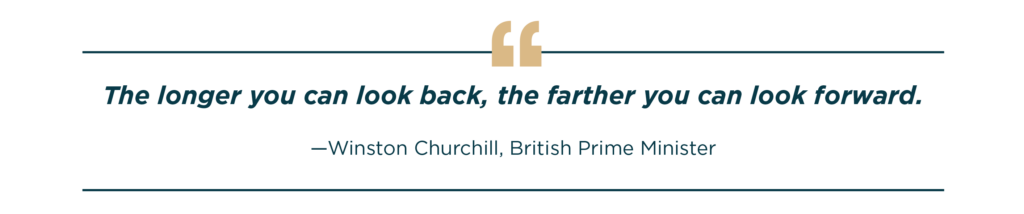
Winston Churchill Quote

Scripture consistently calls God’s people to examine their ways before moving forward (Lamentations 3:40). The Old Testament prophets repeatedly challenged Israel to examine the fruit of their decisions (Jeremiah 6:19, 21:14; Haggai 1:5–7). Neglecting to review the past makes leaders more prone to repeat errors and less likely to formalize the successful strategies that are already working.

For the faith-driven CEO, looking back is also an opportunity to recognize how God has fulfilled His good purposes. Hindsight reveals not only past problems but also blessings and successes that deserve celebration. Good stewards honestly account for both gains and gaps.


Why Most Retrospectives Produce Observations Instead of Clarity

A retrospective is more than a review of past results. It converts experience into insights that guide future decisions. Without a clear structure, retrospective reviews often become blame sessions, celebrations of recent events, or selective memory that avoids the most uncomfortable truths.

The quality of our retrospective reviews determines the quality of the lessons
we learn from them. When leaders look back with honesty and a genuine desire to grow, the past becomes a source of wisdom for what should happen next.

Three Principles That Make a Retrospective Productive

At C12, we’ve observed that the most effective retrospective reviews share structural disciplines that distinguish them from surface-level recaps. Three principles consistently separate the reviews that produce lasting change from those that produce polite agreement.

1. Prepare Before the Conversation Begins

Honest retrospection does not happen in the moment. Invite key leaders in advance and give them time to reflect beforehand. The most valuable preparation question is simple: how much of last year’s strategic plan can you recall without looking it up? Their answer reveals how central the plan was to daily leadership.

2. Facilitate for Honesty, Not Harmony

A safe environment makes honest sharing possible. Start by sharing one leadership assumption that proved wrong. The goal is learning, not blame. The posture that makes candor possible is the assumption that everyone did their best with what they knew at the time, which creates the psychological safety that allows the team to examine outcomes without becoming defensive.

3. Guard Against Recency Bias

The most recent quarter can loom larger in memory than it deserves. Reviewing the year chronologically helps keep earlier lessons from being overshadowed. A productive retrospective measures its success by one standard: did it change something in next year’s plan? If the same blind spots appear in next year’s review, this year’s retrospective didn’t do its job.

Effective retrospection requires data, not merely sentiment. A plan can be executed faithfully and still produce poor results if it was built on faulty assumptions. Likewise, strong results can sometimes mask weak planning. C12’s 5-Point Alignment Matrix (5PAM) provides a balanced scorecard for evaluating each area of the business.

C12's Five Point Alignment Matirx

The Four Questions That Reveal What Last Year Actually Taught You

C12’s Look Back process uses a four-question assessment applied across each area of the 5PAM. This framework converts retrospection from a feelings-based exercise into a structured diagnostic, producing specific insights rather than general impressions. Ask all four questions across each 5PAM area, moving from what’s performing well toward what the next plan must address.

1. What’s Working?

The guiding questions: What’s going better than expected? What’s worth celebrating? What’s succeeding that should be replicated?

The goal is to identify why something is working so those practices can be repeated.

2. What’s Broken?

The guiding questions: What needs improvement? Where are there recurring breakdowns? What’s slowing things down or causing consistent frustration?

The hardest problems to name are often the most important to address.

3. What’s Confused?

The guiding questions: What needs clarification? In what areas do people seem uncertain about their role, their goal, or the standard they’re being held to?

Confusion is different from broken: a broken process fails consistently; a confused process fails inconsistently because people lack a common understanding.

4. What’s Missing?

The guiding questions: What gaps exist in strategy, operations, or products and services? Where is there a genuine need for a new capability, role, process, or decision that does not yet exist?

Missing elements often become next year’s priorities.

What Honest Retrospection Reveals That Planning Alone Cannot

Every insight gained from looking back strengthens the strategic planning that follows.

  • What’s working identifies strengths to build on.
  • What’s broken identifies systems that need attention.
  • What’s confused reveals areas requiring greater clarity.
  • What’s missing defines the gaps the next plan must close.

Strategic plans built on honest reflection rest on wisdom rather than assumptions.

Brian J. Sielaff, CEO of Tamarack Grove Engineering, knows this firsthand. For 14 years, he led his business on what he calls “hope shots”—working hard, keeping his head down, and waiting until December to see how the year turned out. In 2024, that approach caught up with him. Expenses outpaced growth, and as he reviewed the year-end P&L, he asked himself: “Did this happen on my watch?” It did. Hear Brian’s story and discover why looking back may be the most important step toward moving forward.

What This Means for CEOs

The discipline is simple. The willingness is the hard part.

calendar iconBefore building next year’s strategic plan, schedule a dedicated Look Back session with your executive team. Test your own recall of last year’s strategic plan before opening any documents.

question icon Then, apply the four questions across the 5PAM. Aim for at least one honest, specific insight per area. Name your own assumptions that did not produce the results you expected. Your willingness to go first often determines how honest the discussion becomes.

Top starred badge iconMeasure the retrospective’s success by one standard: did this conversation change next year’s plan?


The forward pull of leadership is powerful. There’s always another opportunity to pursue, another challenge to solve, another
vision to build toward. However, leaders who never pause to look back carry their blind spots into every plan they build.

The question worth sitting with before the next planning season begins is not “What do I want to happen next year?” It’s “What did last year actually teach me, and have I been honest enough to learn it?”

Don’t let last year become wasted wisdom. Ask the hard questions. Learn what God is teaching you. Then build your next plan on truth instead of assumptions.
Related Leadership Insights

C12 Business Forums provides an architected environment for Christian business leaders that integrates work, life, and leadership transformation. To learn more about C12’s approach to Christ-centered business leadership, find a C12 Business Forum near you.

September 18, 2026

About the Author

C12 Editorial Team

Related Posts

Woman at a computer planning out budget

The Christian CEO’s Guide to Building a Biblical Compensation Strategy

Few leadership decisions communicate your values more clearly than the way you compensate your people. Compensation decisions are among the most trust-sensitive choices a CEO makes. A single compensation decision can influence employee trust long after the conversation is over. Yet across thousands of C12 Forums, we observe the same pattern: Most compensation strategies are built around fear, market mimicry, or compliance minimums, not around the principles that actually produce a thriving workforce.

Read More »