

The Curious Executive – Part One
Why Great Leaders Ask Better Questions
Most executives feel an unspoken pressure to have all the answers. But the most effective leaders operate differently. They lead with questions.
In this two-part series, we’ll explore the underrated leadership tool of curiosity and learn to ask better questions that produce stronger teams, clearer strategy, and better results.
The quality of your leadership is directly tied to the quality of your questions. The leaders who learn to ask the right ones often discover insights and opportunities they would never uncover alone.
The Question That Built Disney World
Walt Disney is widely known as one of the most innovative entrepreneurs in modern history. Long before Disney World became a global destination, Disney faced widespread skepticism when he purchased thousands of acres of seemingly worthless swamp land in Florida.
Critics looked at the land and saw risk, uncertainty, and poor judgment.
Disney looked at the same land and asked a different question: What could this become?
That question changed everything.
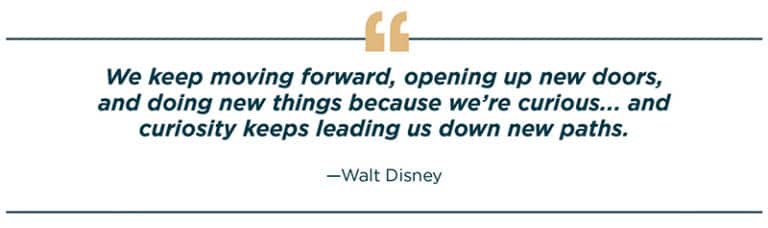
Disney’s story illustrates something important about leadership: Progress rarely begins with certainty. It begins with bold questions others fail to ask.
The Leadership Myth of Having All the Answers
Many leaders feel pressure to project certainty. Executives are expected to move quickly, make confident decisions, and provide direction to their teams. This expectation can create an unspoken leadership myth: “Good leaders already know the answers.”
Effective leaders understand that this assumption can actually limit their effectiveness. When leaders believe they must have all the answers:
- Conversations become one-directional.
- Employees stop offering ideas.
- Innovation slows.
- Engagement declines.
Curiosity changes that dynamic.

When leaders ask thoughtful questions, they access insights and perspectives they would never discover on their own. Every team member brings a different vantage point, and those viewpoints are unlocked when leaders create space.
The Power of Inquiry in Leadership
Curious leadership communicates something powerful to a team: Your perspective matters.
Questions shape culture.
Leaders who consistently ask thoughtful questions create an environment where curiosity becomes part of the organization’s DNA. When leaders shift their approach from directing to inquiring:
- Hidden insights appear. Employees across an organization see different aspects of the business. Frontline staff may notice operational challenges that leaders cannot see. Managers may identify customer trends before executives recognize them. Questions surface these insights.
- Trust builds. When leaders ask sincere questions and listen carefully to the responses, employees feel heard and respected. Over time, trust naturally develops.
- Ownership increases. People commit to ideas they help shape. When employees contribute to decisions, they become invested in the outcomes. Questions invite that participation.
Two Types of Leaders: Multipliers and Diminishers
Leadership researcher Liz Wiseman describes two types of leaders in her book Multipliers: those who multiply and those who diminish.
The Multiplier Leader
Multiplier leaders focus on amplifying the intelligence and capability of their teams. They recognize that leadership is about unlocking collective organizational intelligence, not demonstrating personal brilliance.
Multiplier leaders frequently ask:
- What do you think about this?
- What opportunities might we be missing?
- How would you approach this problem?
These questions invite others to think critically and contribute their expertise.
They also create an environment where employees feel empowered to contribute ideas, develop solutions, and take ownership of their work.
Research suggests that Multiplier leaders may access 70–100% of their team’s capabilities.
The Diminisher Leader
Diminisher leaders operate from a different mindset. They believe strong leadership requires having the answers and maintaining control. As a result, they tend to dominate conversations, make decisions independently, and dismiss others’ input.
Employees under this leadership style often hesitate to share ideas or challenge assumptions. Eventually, this leads to disengagement and reduced creativity.
Organizations led by Diminishers often access only 20–50% of their team’s potential.
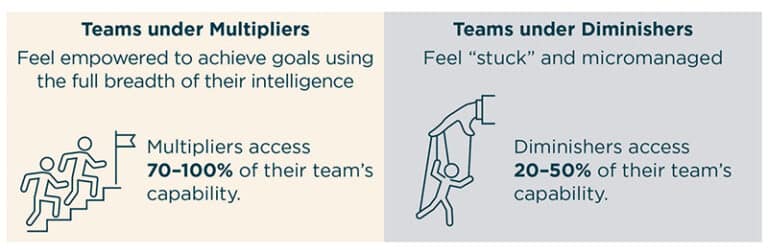
While Multipliers leverage curiosity-driven leadership to unlock their team’s full potential, Diminishers hinder growth by relying on command-and-control. Are you more inclined to ask questions or to give directions?
The Leadership Shift That Changes Everything
One powerful shift a leader can make is moving from answer-driven leadership to question-driven leadership. Instead of asking, “How quickly can we fix this?” curious leaders ask: “What are we missing?” Instead of saying “Here’s the plan,” they ask, “What ideas do you have?”
This shift may feel uncomfortable at first, particularly for leaders accustomed to providing direction. The long-term impact, however, can be profound:
☐ Collaboration increases
☐ Employees engagement improves
☐ Superior solutions emerge
☐ Leaders gain undiscovered insights
The First Step Toward Curious Leadership
Curiosity begins with humility. It requires leaders to acknowledge that they don’t have all the answers. When leaders approach conversations with genuine interest, they demonstrate respect for the people around them and create space for deeper dialogue. To begin cultivating curious leadership today, start with a simple shift. Replace solutions with questions:
- What do you see that I might be missing?
- What opportunities should we consider?
The insight that emerges when people are invited to think rather than simply follow directions might surprise you.
Of course, not all questions are equally effective. Some questions limit conversation, while others unlock deeper understanding and better decisions.
In part two, we’ll explore practical frameworks you can use to ask better questions—questions that clarify strategy, strengthen relationships, uncover root problems, and move organizations forward.
If you want to lead at your highest level, become a leader who asks the questions that unlock the best thinking in the room.
C12 Business Forums provides an architected environment for Christian business leaders that integrates work, life, and leadership transformation. To learn more about C12’s approach to Christ-centered business leadership, find a C12 Business Forum near you.
April 29, 2026