
Cost Leadership: A Strategic Discipline for Protecting Margin
Designing a Cost Structure That Sustains Both Performance and Purpose
If you’re a business leader, you likely ask some version of the question: How do we protect margin in an environment that feels relentlessly unstable?
Labor shortages. Supply chain disruptions. Rising interest rates. Inflation. Tariffs. Capital market instability. Softening consumer confidence. In a VUCA environment (volatile, uncertain, complex, and ambiguous), economic pressure is the air we breathe.
In this climate, cost leadership is a strategic necessity.
What Is Cost Leadership?
Cost leadership is a strategic approach to reducing production and operating costs by increasing efficiency, scaling operations quickly, and improving processes. The goal is to operate so efficiently that you can offer competitive pricing while maintaining quality and strong profitability.
This raises a critical distinction:
Cost leadership reduces internal costs to support profitability and competitive positioning.
Price leadership attempts to offer the lowest prices in the market, often at the expense of margins.
Many leaders confuse the two. When margins tighten, the reflex is to cut prices or slash expenses indiscriminately. However, reactive cost-cutting and strategic cost leadership are not the same.
Cost-cutting is episodic and defensive.
Cost leadership is cultural and proactive.
When done well, cost leadership:

Expands Market Share

Strengthens resilience in downturns

Increases profitability through higher margins

Frees capital for innovation and growth
The question is not simply, “Where can we cut?” It’s, “How can we build a system that consistently protects margin without compromising our value proposition?”
Are You Cutting Costs or Undermining Your Value?
Every cost decision must align with the value your company promises.
Some companies compete primarily on high quality: personalized service, deep relationships, and premium positioning. Others compete on low cost: affordability, convenience, streamlined delivery.
A premium provider cannot aggressively slash costs without risking brand trust. A low-cost provider cannot tolerate inefficiencies and survive.
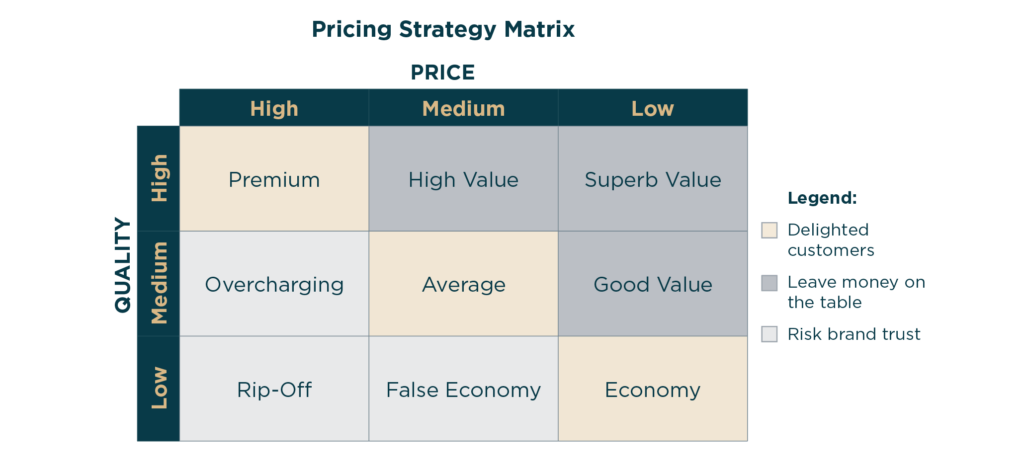
Businesses generally fall into one of nine pricing strategy categories, based on the relationship between what you charge and the quality you deliver. The Pricing Strategy Matrix can help you assess whether you delight customers, leave money on the table, or risk brand trust. Long-term performance depends on alignment.
- Companies that charge premium prices need to consistently deliver premium value to sustain trust.
- Companies that deliver exceptional value must ensure pricing and cost structures support healthy margins.
Cost leadership helps leaders maintain this alignment by ensuring the business’s economics reinforce its intended market position.
As a leader, you should be asking:
- Are we delighting customers or leaving money on the table?
- Are we cutting costs in ways that erode trust?
- Is our cost structure reinforcing or contradicting our strategic identity?
Cost leadership must reinforce who you are, not distort who you are. Strategy shows up in daily decisions, trade-offs, and habits across the organization. Even the clearest cost leadership strategy will fail if it never takes root in culture.
How Do You Build a Cost-Conscious Culture?
At C12, we often say: No margin, no mission.
Without margin, your mission stalls. With margin, your mission thrives.
Cost leadership is not about telling your team to “do more with less.” It’s about setting a stewardship tone across the organization. That means:
- Aligning cost decisions with mission and values
- Empowering teams to suggest efficiency improvements
- Establishing smart metrics and incentives
- Communicating why cost leadership matters
- Demonstrating accountability for what God has entrusted
Cost leadership is an evergreen discipline. While it is easy to chase revenue at the cost of margin, cost leadership keeps the focus on profit, purpose, and sustainability.

In a crisis, reactionary cuts can harm the future. Strategic leaders pause to ask, “What serves today’s needs and tomorrow’s mission?”
Are You Measuring What Matters?
Cost leadership becomes sustainable only when leaders consistently measure the right things. Metrics provide clarity and help leaders move from reactive decisions to informed stewardship by revealing where efficiency-supporting strategies are and where hidden costs are undermining them.
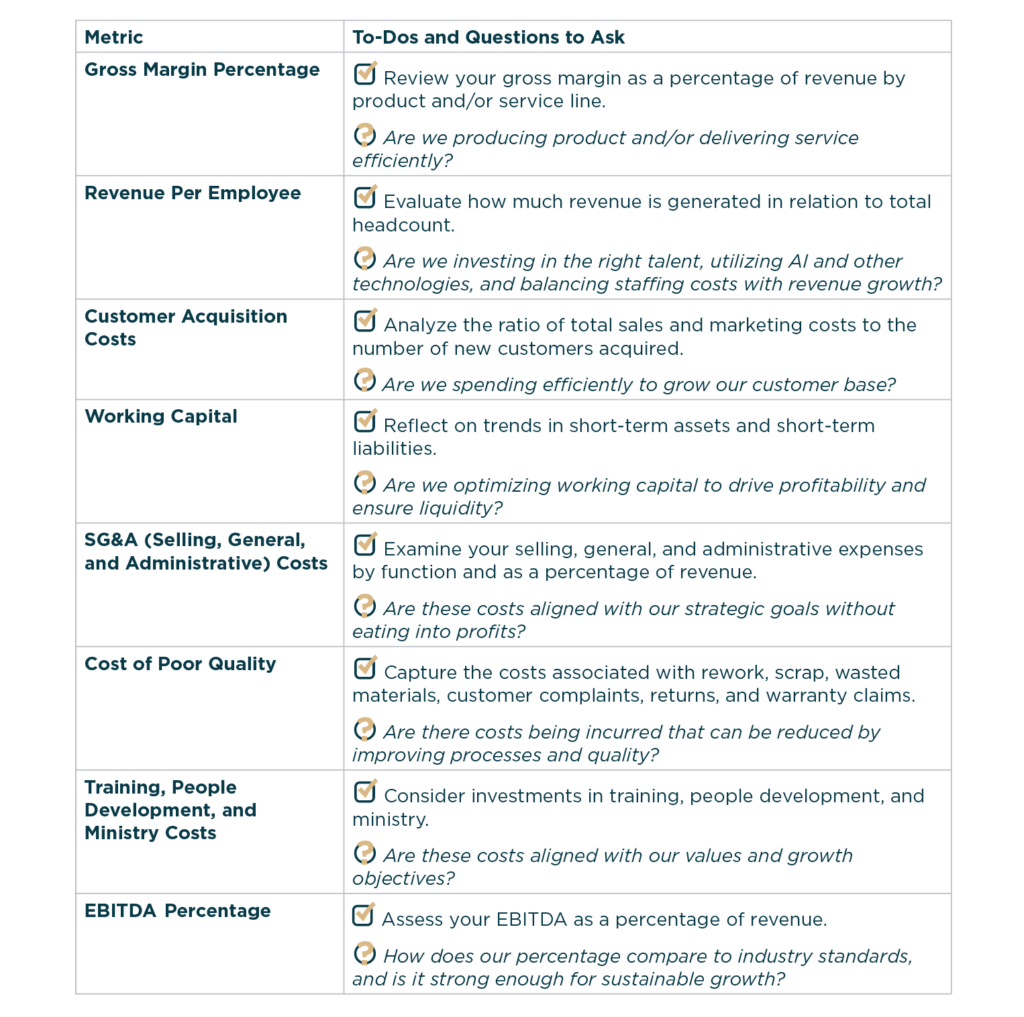
Taken together, these measures provide a dashboard for stewardship. No single metric tells the whole story, but patterns over time reveal whether your cost structure reinforces or constrains your mission.
By assessing these areas and empowering your teams to make data-driven decisions, you can uncover cost-saving opportunities that support both financial health and mission impact. A typical process is to analyze historical trends, compare those to internal forecasts, and benchmark against industry standards.
Five Strategic Paths Under Pressure
When margins erode, leaders face a narrow set of strategic choices, each carrying meaningful trade-offs:
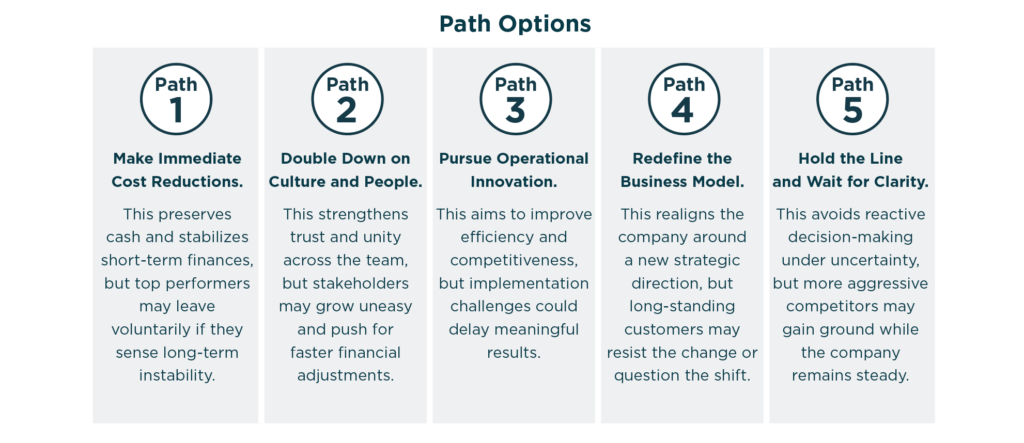
When facing these options and evaluating the path forward, you can ask yourself:
- What decision have I been postponing?
- What courageous conversation must I initiate?
- What metric, if changed, would drive better stewardship?
- What strength can we leverage in our current margin strategy?
The right choice depends on your strategy, culture, capital structure, and competitive landscape. What matters most is not speed but alignment.
Faithful Stewardship for Kingdom Impact
From a C12 perspective, cost leadership is about stewardship. God has entrusted you with capital, people, influence, and opportunity. Stewarding those resources wisely means building systems that protect margin, fund innovation, strengthen culture, and advance Kingdom impact.
When cost leadership is embedded in culture, aligned with strategy, and rooted in biblical values, it becomes a lasting advantage.
How will you build a company resilient enough to serve, employ, invest, and impact for decades to come?
C12 Business Forums provides an architected environment for Christian business leaders that integrates work, life, and leadership transformation. To learn more about C12’s approach to Christ-centered business leadership, find a C12 Business Forum near you.
March 30, 2026