
The Curious Executive – Part Two

How to Ask Questions That Transform Your Business
Post
Share
Post

In part one of this series, we explored why curiosity is one of the most powerful (and often overlooked) leadership strengths. Leaders who resist the pressure to have all the answers and instead ask thoughtful questions unlock their teams’ intelligence, build trust, and create more engaged organizations.

But curiosity alone isn’t enough.

Leaders must also learn to ask questions that move conversations forward and generate meaningful insight. The right question can clarify strategy, uncover hidden problems, and spark new ideas. The wrong one can shut down dialogue before it even begins.

In this article, we’ll explore the types of questions great leaders ask and how they apply curiosity across key areas of leadership.

Post
Share
Post

The Difference Between Closed and Open Questions

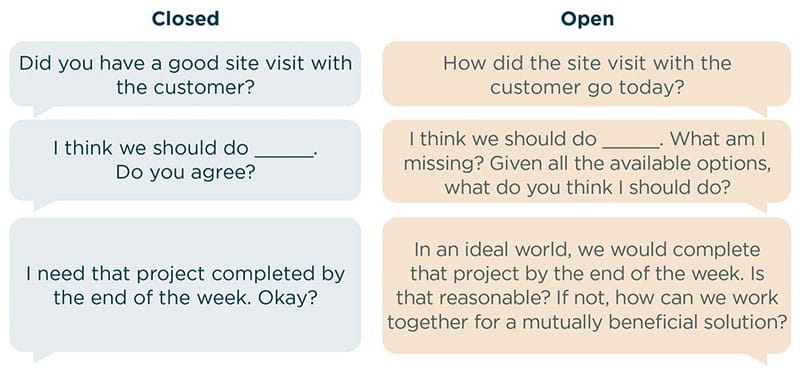
One of the simplest ways to improve your leadership conversations is to shift from closed questions to open-ended ones.

Closed questions often produce short answers and limit discussion. For example: “Did the meeting go well?” This question invites a quick “yes” or “no” response.

Open-ended questions, however, encourage deeper reflection and conversation. For example: “What stood out to you during the meeting?” This question invites insight, perspective, and analysis.

Open-ended questions typically begin with words such as “What,” Why,” “How,” “Describe,” and “Tell me about.”

Curious leaders use open questions to create space for thoughtful dialogue rather than surface-level responses.


The Right Questions Framework

One practical way to ask better questions is to think through seven core interrogatives that guide deeper thinking and more productive conversations. Each type of question uncovers a different layer of insight and helps leaders move from vague discussion to greater clarity and alignment.

Why Questions — Purpose and Motivation

Why questions help leaders explore the deeper motivations behind decisions, actions, and priorities. 

  • Why does this initiative matter to our company?
  • Why do customers choose us over competitors?
  • Why is this goal important right now?

These questions uncover purpose and ensure the organization is pursuing what truly matters

Where Questions — Direction and Vision

Where questions focus on direction and context. 

  • Where are we seeing the greatest opportunities for growth?
  • Where are we falling short of expectations?
  • Where do we want the organization to be in three to five years?

These questions help leaders assess the present while clarifying the path forward. 

What Questions — Clarity and Outcomes

What questions clarify goals, priorities, and definitions of success. 

  • What are we ultimately trying to accomplish?
  • What obstacles might prevent success?
  • What would success look like for this initiative?

These questions align teams around shared outcomes.

Which Questions — Options and Decisions

Which questions help leaders evaluate alternatives and make informed decisions. Which opportunity should we pursue first?

  • Which option aligns best with our mission and strategy?
  • Which solution provides the greatest long-term value?

These questions sharpen decision-making when multiple paths are available.

How Questions — Execution and Process

How questions focus on the methods and processes required to achieve a goal. 

  • How could we approach this challenge differently?
  • How might we implement this idea effectively?
  • How will we measure progress along the way?

These questions help teams think through implementation and execution.

Who Questions — Ownership and Relationships

Who questions clarify roles, responsibilities, and relationships. 

  • Who should be involved in this decision?
  • Who is best equipped to lead this initiative?
  • Who else might have insight into this issue?

These questions help ensure that the right people are involved and that ownership is clearly defined.

When Questions — Timing and Priorities

When questions clarify timelines and urgency. 

  • When should this initiative begin?
  • When will we know if we are succeeding?
  • When should we revisit or reassess this strategy?

These questions help teams prioritize actions and align expectations across the team.

Where Curious Leadership Makes the Biggest Impact

Curiosity becomes most powerful when applied to key leadership responsibilities. 

Defining Mission, Vision, and Core Values

A company’s mission, vision, and core values define its purpose and direction. These principles should not emerge from one leader’s ideas alone.

Curious leaders invite others into the process by asking questions such as:

  • Why does our organization exist?
  • Who are we ultimately serving?
  • What kind of impact do we want to make in the world?
  • What behaviors should define our culture?

These conversations create clarity and alignment around the company’s purpose. They also encourage ownership of the organization’s values and direction.

Strengthening Strategic Planning

Strategic planning often begins with the right questions. Instead of jumping directly into solutions, you can guide discussions with questions like:

  • What has contributed most to our success in the past?
  • What changes are shaping our industry today?
  • What opportunities are emerging that we have not yet pursued?
  • What metrics best measure our success?

These questions help teams evaluate the past, understand the present, and prepare for the future. They also encourage teams to think strategically rather than reactively.

Managing and Developing People

Leadership ultimately involves achieving results through people. Curious leaders use questions to understand their team members and support their growth.

Instead of simply assigning tasks, you can ask questions like:

  • What are you currently focused on?
  • What challenges are you encountering?
  • What support would help you succeed?

These conversations demonstrate a genuine interest in employees’ development while encouraging greater ownership.

Identifying and Solving Business Problems

Many business challenges are symptoms of deeper issues. Curious leaders use questions to uncover root causes. One helpful approach is the Five Whys method, which involves repeatedly asking “why” until the underlying issue becomes clear. For example:

  1. Why did the issue occur?
  2. Why did that condition exist?
  3. Why was it not addressed earlier?
  4. Why does the system allow it?
  5. Why has it persisted?

Each question moves closer to the root cause. Once the problem is identified, leaders can shift toward solution-focused questions:

  • What if we approached this differently?
  • What potential solutions should we explore?
  • How could we implement the best option?


This process encourages thoughtful problem-solving rather than quick fixes.


The Curious Executive’s Leadership Advantage

Great leadership is not defined by having all the answers. It’s defined by asking the questions that help everyone discover them. Curiosity is a strategic advantage. Leaders who consistently ask the right questions create organizations that learn, grow, and adapt more effectively.

Before your next meeting, strategy session, or one-on-one conversation, pause and consider this: What question could unlock the best thinking in the room?

Lead with curiosity. Ask one more question. Listen a little longer. You may discover that the next breakthrough idea, overlooked opportunity, or solution doesn’t begin with a better answer but with a better question.

C12 Business Forums provides an architected environment for Christian business leaders that integrates work, life, and leadership transformation. To learn more about C12’s approach to Christ-centered business leadership, find a C12 Business Forum near you.

May 27, 2026

About the Author

C12 Editorial Team

Related Posts