
What Should You Stop Doing to Make Room for What Matters Most?
Executive Summary
- Successful organizations often accumulate meetings, processes, reports, and initiatives faster than they remove them.
- Prioritization and process improvement can help manage the workload, but they do not address work that no longer needs to exist.
- Strategic reduction gives leaders a practical discipline for removing unnecessary work and protecting capacity for higher-value priorities.
By C12 Editorial Team
Christian CEO Peer Advisory & Business as a Ministry Contributors
November 2026 | 7-Minute Read
Pillar: CEO Stewardship & Leadership Weight
Most leaders are skilled at addition. When a problem emerges, they introduce a process. When they need greater visibility, they request a report. When an opportunity appears, they launch an initiative.
Each decision may make sense on its own. Over time, however, meetings, processes, reports, and initiatives accumulate faster than anyone removes them, until the organization is carrying far more than leaders intended.
Strategic reduction is the discipline of intentionally removing work that no longer creates enough value to justify the capacity it consumes. Instead of only asking how to prioritize or improve existing work, leaders also consider whether some of that work should continue at all.
Juliet Funt, CEO of the Juliet Funt Group and author of A Minute to Think, offers a practical approach to this challenge.
Strategic Reduction Creates Room for Better Work
Organizations are naturally better at starting things than stopping them. Activities, processes, and expectations can become permanent without anyone periodically evaluating whether they still serve their original purpose.
Funt describes the solution as developing a reductive mindset. Rather than assuming progress always requires something new, leaders intentionally look for opportunities to remove, simplify, or stop work that no longer advances the mission.
This is different from prioritization and improvement. Prioritization determines which responsibilities receive attention first. Improvement makes existing work more efficient. Both help leaders manage the workload, but neither addresses work that no longer needs to exist. Reduction goes a step further by asking whether the work belongs in the organization at all.
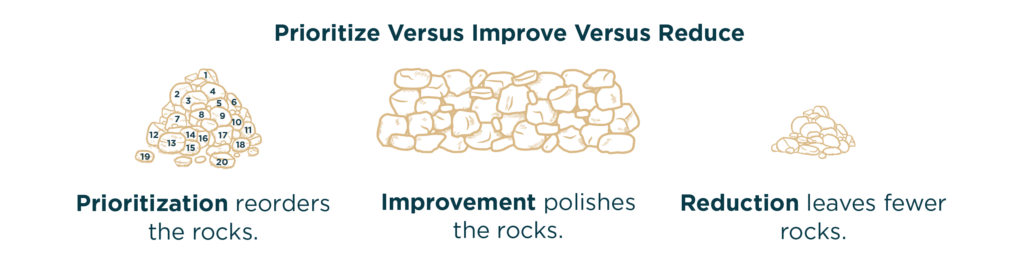
That distinction is important because a company can become highly efficient at doing things that no longer create meaningful value.
Employees may learn to manage an overloaded list of priorities when the healthier solution is to shorten it.
Strategic reduction challenges leaders to examine the weight their organizations have accumulated and determine what still deserves to be carried.
In the video below, Funt explores the leadership bias toward addition and uses examples such as LEGO’s experience with complexity and SpaceX’s focus on removing unnecessary elements.
Her central challenge is straightforward: leaders should not only ask what they can build, improve, or add. They should also ask, “What can we remove?” That question can expose work that has survived primarily because no one has reconsidered it.
The Spin Launcher Turns Frustration Into Action
Senior leaders are not always the first to recognize unnecessary work. Employees who operate inside recurring processes often have the clearest view of organizational friction. They know which reports take significant time to prepare but receive little attention, which meetings routinely end without decisions, and which approvals slow the business without creating meaningful value.
The problem is often not awareness but permission.
Employees may assume that questioning an established process will make them appear resistant. They may continue producing a report because an executive requested it years ago, even if no one can explain how it is currently used. Without a constructive process for challenging unnecessary work, inefficiency can become part of the culture.
Funt’s Spin Launcher gives teams a structured way to move from frustration to responsible reduction. The framework follows five steps:
Generate → Separate → Evaluate → Eliminate → Liberate
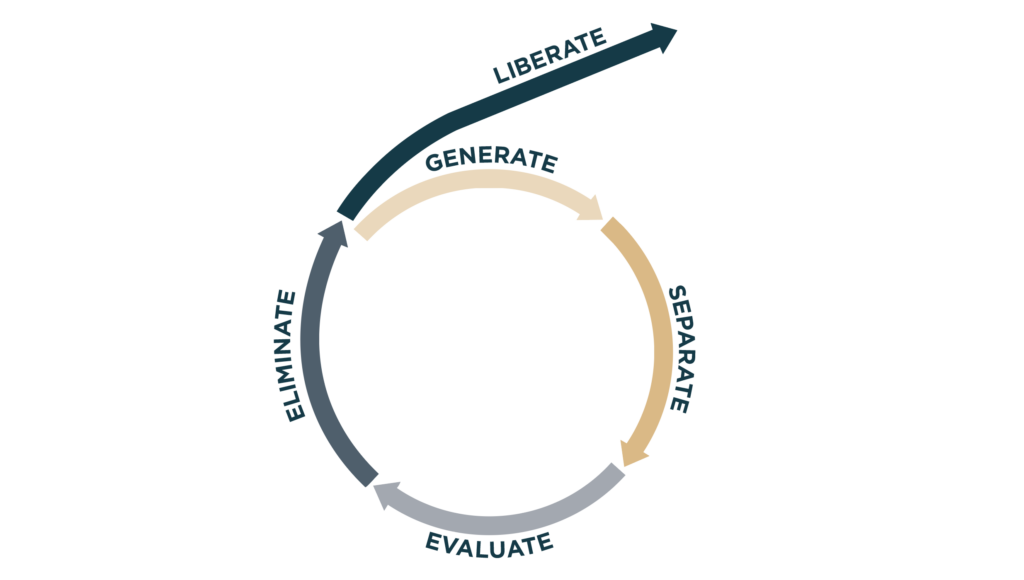
The process begins with team members completing a simple statement: “I wish we could stop ______.” This surfaces possibilities before defending the status quo.
Teams then separate what they can control from what they cannot, focusing attention on areas where they have authority to make a change.
Next, they evaluate each activity based on its mission proximity. Work that directly advances the mission should receive different consideration from work whose connection has become difficult to explain.
The fourth step is elimination. Rather than simply complaining about a frustrating process, team members propose what should stop, shrink, or change.
Finally, the team identifies what the reduction liberates. Reclaimed capacity should be protected and redirected intentionally toward higher-value priorities.
In the video above, Funt explains how leaders can use the Spin Launcher to turn vague frustration into thoughtful action.
The goal is not indiscriminate cutting. Some difficult, time-consuming work is essential. The framework helps teams distinguish between work that is demanding because it matters and work that continues simply because it has become familiar.
A leadership team can start small: identify a single meeting, report, process, or approval and walk it through the five steps.
Reduction Must Become an Ongoing Habit
One round of strategic reduction can create immediate relief, but complexity has a way of returning.
New opportunities lead to new initiatives. Problems create new procedures. Information requests become recurring reports. Without regular maintenance, organizations can quickly refill the capacity they worked to reclaim.
That is why Funt recommends establishing a haircut habit. Just as regular maintenance keeps small problems from becoming large ones, leaders can create a recurring rhythm to evaluate what has accumulated and trim what is no longer necessary.
Consider dedicating one hour each month and three hours each quarter to strategic reduction. While the exact timing can vary, the principle remains: subtraction should become a normal part of the operating rhythm, not an emergency response to burnout or overload.
This discipline also applies to the CEO’s own leadership habits.
Executive behavior can create significant downstream work. A loosely worded email can generate a long communication cycle. An unnecessary meeting consumes the time of everyone invited. A new idea mentioned casually by the CEO can quickly become an unofficial assignment for several employees.
That means leaders need to examine not only organizational systems but also the ways their own communication, meetings, and ideas create work for others.
Funt also encourages leaders to resist activating every promising idea immediately. She describes this as “buying a freezer” for new ideas. Giving an idea time to mature before turning it into an initiative can protect teams from constantly absorbing new priorities before completing or removing existing ones.
This final video brings the reductive mindset into everyday executive leadership. Funt explores practical habits for managing email, meetings, and new ideas that can prevent unnecessary work from accumulating in the first place.
These habits can improve efficiency, but efficiency is not the ultimate objective. The greater goal is to protect organizational capacity so people can devote their best thinking, energy, and attention to the work that most advances the mission.
Reduction Is a Stewardship Decision
For the faith-driven CEO, strategic reduction is also a stewardship issue. Leaders have been entrusted not only with financial resources but also with the time, attention, creativity, and talent of the people they lead.
John 15 offers a picture of greater fruitfulness through pruning. Jesus describes the Father as the vinedresser who prunes fruitful branches so they can bear even more fruit. Pruning is not an end in itself. What is removed creates greater capacity for what should grow.
The same principle can inform how we lead our businesses.
The leadership question, therefore, is not simply, “Is this good?” It is, “Is this still the best use of what has been entrusted to us?”
Strategic reduction gives leaders a practical discipline for answering that question: removing unnecessary work and protecting capacity for the priorities that matter most.
What This Means for CEOs
- Treat reduction as part of strategy, not merely a response to overload.
- Evaluate existing work according to how closely it advances the mission.
- Give employees permission to identify activities that no longer create sufficient value.
- Examine how your own leadership habits create additional work for others.
- Establish a recurring rhythm for removing complexity before it becomes entrenched.
Most organizations already know what they want to start next. Strong leadership also requires clarity about what needs to stop.
Before adding another priority, process, meeting, or initiative, ask what you could remove first. The capacity your organization needs for its next season may already exist. It may simply be occupied by work you no longer need to carry.
Related Leadership Insights

C12 Business Forums provides an architected environment for Christian business leaders that integrates work, life, and leadership transformation. To learn more about C12’s approach to Christ-centered business leadership, find a C12 Business Forum near you.
November 13, 2026